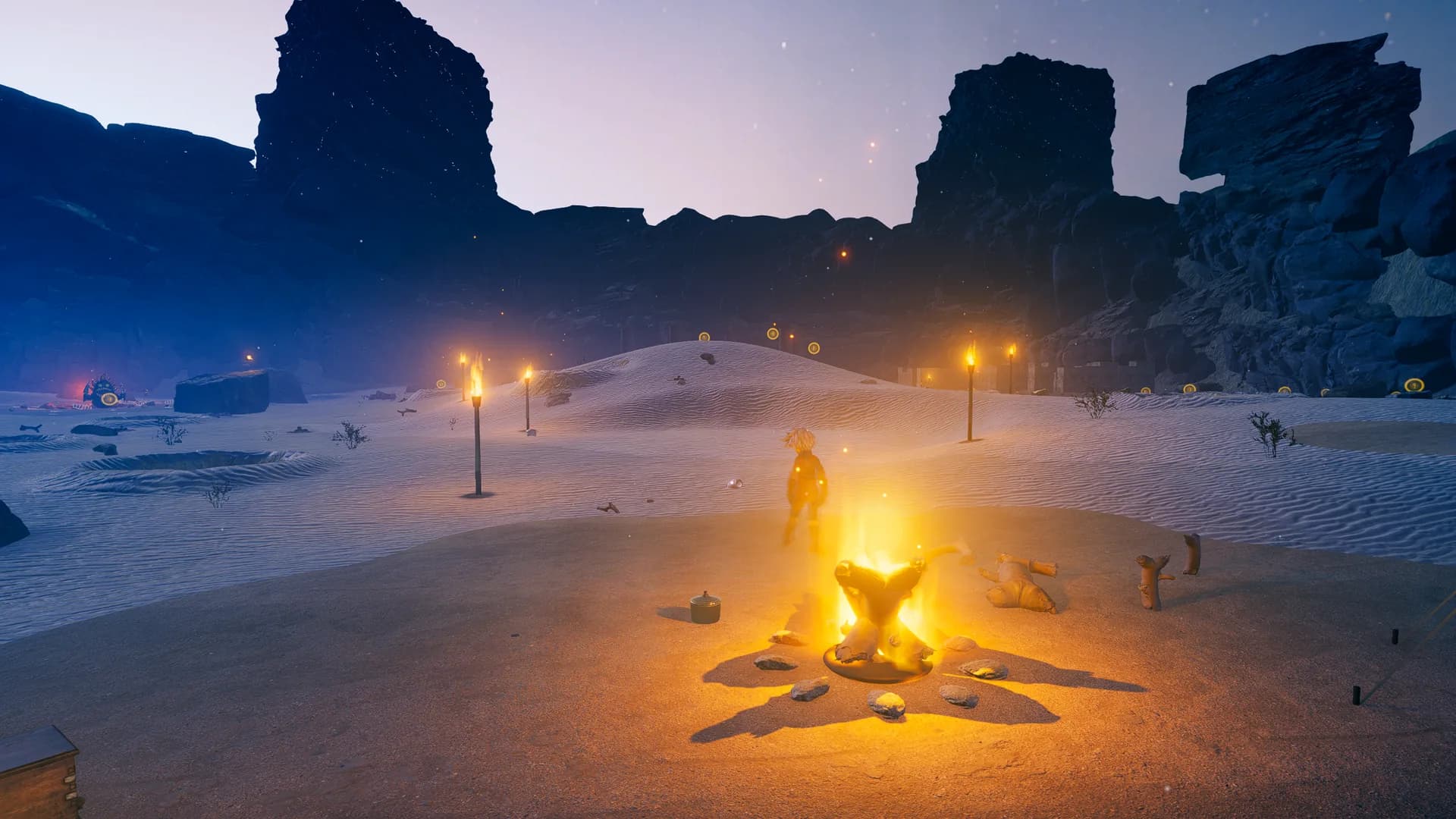
The bit nobody shows you: how an idea becomes a game you can actually play. We're learning as we go, so we're writing it down.
Making a game isn't one big job. It's lots of small ones, in a sensible order, with a lot of playing in between. Here's our order. Real game makers do more or less the same thing, just with bigger teams.
Benjamin
Invented the desert, the monsters and their names.
Drew every monster first, on paper, in 2023.
Wrote the rules of the board game and made the first cards by hand.
Decided how each monster hunts: Hungry chases, Thirsty hears, the Hymotyzer needs eye contact, Rope Guy traps.
Designed the video game's rules: survive until dawn, hiding holes, the Golden Compass, Infinity mode and how you unlock it.
Plays every new version and decides what changes.
Decided how the sounds work.
Is writing the intro narration himself.
Dad
Turns Benjamin's decisions into instructions for the computer.
Runs the playtests, keeps the lists of bugs and ideas, and keeps the versions straight.
Explains how real product teams work, and makes Benjamin use the same tools.
The computer
Writes the code from the instructions.
Turns the drawings into artwork and 3D models.
Runs the tests overnight and writes a report for the morning.
Never decides what the game is. If nobody tells it the rules, nothing happens.
01
Start with the idea, and write it down.
Benjamin's idea fitted on one page: survive the night, four monsters, hide or run, don't fight. Writing it down matters, because later, when we're arguing about whether you should be able to swim, we can go back and check what the game is really about.
02
Build the smallest thing that works (the MVP).
Before any 3D monsters or fancy lighting, we built a tiny version of the game in a web browser in a couple of days: one lobby, three portals, one map, blocky monsters, and a screen that said "Caught by Hungry". It looked rough. It was supposed to. The point was to find out, as quickly as possible, whether the idea was fun.
The browser version, October 2026
"Don't show items you haven't got."
03
Play it. Then watch other people play it.
We play every version. Then we watch Benjamin play it, and then his friends, without telling them what to do. People don't do what you expect. They jump into holes instead of pressing E. They stand in the water because they think they're safe. Every surprise is a note in the list.
BENJAMIN'S DECISIONS
Every playtest ends with questions. Benjamin answers them; that's the job of a designer. These are real ones from 14 October 2026.
Normal is too hard. What do we change?
Only a little. Make Thirsty a bit easier. Leave Hungry exactly as he is.
Hungry is meant to be the scary one.
You can get stuck in a hole if you don't press E. What should a hole do?
Unless you press E, a hole is just a dip in the ground. You can always walk or jump out. E means hide; E again means climb out.
The night is too dark.
Make it brighter so you can see the paths and the holes. Keep the darkest moments for Midnight and the Witching Hour. Add a brightness slider in Settings.
How do you unlock Infinity mode?
You have to survive a full twelve-minute Hard night. Call the Sun, the Golden Compass, cheats and test shortcuts don't count.
Otherwise it isn't earned.
How long can you stay in cold water?
Forty-five seconds. Keep it.
In multiplayer, how do you rescue a friend?
Walk up and hold E for three seconds. You're exposed while you do it.
Who writes the intro narration?
Benjamin. Leave a placeholder; he'll write it himself.
04
Decide what's next (the roadmap).
We can't build everything at once, so we keep a list in three columns: Now, Next and Later. Now is what we're building this week. Next is what we've decided to do. Later is every good idea we're not ready for yet. Benjamin's Infinity mode sat in Later for exactly one day.
Now
Fixing what early access players find
Making playing together smoother
Next
Getting ready for Steam
The Neighbourhood (a new map)
Later
Benjamin's own voice in the game
Touch controls, one day
05
Keep a list of what's broken (bugs and issues).
A bug is when the game does something it shouldn't: a rock you can see through, a monster that gets stuck, a hero who can climb walls. We keep every one in a list with a number, and we fix the worst one first, not the easiest. In the game, pressing F8 saves a bug report so testers can send us exactly what went wrong.
BUG-18 · Jumping into a hole hid you in 0 out of 22 holes.BUG-41 · A 4,200 Hz tone played all night in the Oasis.BUG-62 · Rocks had two detail levels fighting over the same mesh.
06
Make small versions, often.
We don't build for months and then show it. Every day or two there's a new numbered version: 0.6, 0.7, 0.8. We keep two copies of the game: a safe one everyone can play, and a messy one where new things get tried. Nothing moves from messy to safe until it passes every check.
07
Check it before anyone else sees it.
The game tests itself: hundreds of automatic checks run every time something changes, and a robot plays whole nights while we're asleep. If a check goes red, nothing gets released. Then we test it on an old laptop, and on Windows, because it works on Dad's Mac isn't good enough.
08
Share it carefully (the beta).
A beta is a version that's nearly ready but still has rough edges, given to a few people who've agreed to find them. Friends first, then more friends. Every one of them tells us something we didn't know.
09
The big decisions are Benjamin's.
Dad writes the instructions. The AI writes the code. But every decision about what the game is is Benjamin's, and we keep a list of them: how long a night lasts (5, 8 or 12 minutes), that you have to press E to hide, that Thirsty was too strong, that Infinity mode only unlocks when you've beaten Hard properly.
Night lengths are 5, 8 or 12 minutes.
You must press E to hide.
Thirsty was made easier after playtests.
Infinity mode unlocks after a full Hard win.
"Make it harder at night and easier at dawn."
The rules we try to stick to
Make it playable before you make it pretty.
One thing at a time.
If it isn't tested, it isn't done.
Write it down.
Fix the worst bug first.
It's fine to be wrong. Change it.
Words you might not know
MVP
The smallest version of something that's still worth using. Ours was a browser game with blocky monsters.
Playtest
Playing a game on purpose to find what's fun, confusing or broken.
Roadmap
Our list of what we're building now, next and later.
Bug
A mistake that makes the game do something it shouldn't.
Rig
The digital skeleton inside a 3D model so it can bend and move.
Beta
A nearly-finished version given to a few people to find the rough edges. Ours came before early access.
Build
A packaged version of the game you can run on a computer.